
CRISPR Knockout (KO) Cell Pools: Approach to Study Gene Function

A Fast and Powerful Approach to Study Gene Function: CRISPR Knockout Cell Pools (KO Pools)

CRISPR/Cas9 has emerged as a groundbreaking genome editing technology with the potential to transform biomedical research. Among its most prominent applications is the targeted knockout (KO) of genes to decipher their functions. One of the most efficient strategies in this domain is the creation of knockout cell pools (KO pools)—a population of cells that have undergone CRISPR-mediated genome editing, eliminating the need for isolating individual clones.
This approach offers a rapid and cost-effective alternative to traditional single-clone selection, enabling functional analysis in a mixed population of edited and unedited cells. Due to its simplicity, high efficiency, and scalability, KO pool generation has become the method of choice for many researchers exploring gene function across a wide range of cell types.
What is a KO Pool?
A KO pool is a population of cells that have been transfected with CRISPR/Cas9 constructs targeting a specific gene. Instead of isolating and expanding individual clones, the mixed population—containing various indel mutations or frameshift knockouts—is used directly for downstream assays.
Key Advantages:
- · Eliminates time-consuming single-cell cloning
- · Allows rapid screening and phenotypic analysis
- · Reduces costs and accelerates experimental timelines
- · Enables more representative biological responses at the population level
- · Provides more complete and stable gene silencing compared to RNA interference (RNAi)
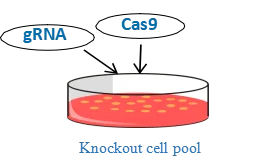
Figure 1. crispr ko cell pool
Applications of KO Pools
High-efficiency KO pools are compatible with a wide range of biological assays, particularly those requiring fast and scalable analyses. Common applications include:
-
1.Proliferation and viability assays
Evaluate the impact of gene knockout on cell growth or survival. -
2.Functional genomics and gene discovery
Identify novel oncogenes, tumor suppressors, or essential genes via pooled screens. -
3.Drug response and target validation
Assess gene function in pharmacological contexts and identify druggable vulnerabilities. -
4.Disease model development
Generate gene-deficient models in primary or iPSC-derived cells for translational research. -
5.Antibody validation (e.g., Western blot, IF)
Use KO pools to confirm antibody specificity by complete loss of target protein expression.
EZ-editor™: A Next-Generation Gene Editing Platform
To meet the growing demands of high-efficiency gene editing, Ubigene has developed EZ-editor™, an advanced platform for cell line engineering and KO pool generation. Built upon the CRISPR/Cas9 system, EZ-editor™ integrates several innovations that ensure high editing precision, efficiency, and reproducibility.
Key Features of EZ-editor™:
- · Custom gRNA Design Algorithm: Proprietary computational tools optimize guide RNA design based on genomic features of specific cell lines.
- · Dual gRNA Synergistic Targeting: Targeting two proximal sites (40–300 bp apart) increases the likelihood of inducing large deletions or complete gene knockout.
- · High-Throughput Molecular Validation: Accurate detection of editing outcomes using qPCR, NGS, mass spectrometry, or high-content imaging.
- · Optimized Protocols for Diverse Cell Lines: Proven transfection/editing conditions for hundreds of common and hard-to-transfect cell types.
- · Miniaturized Genotyping for Single-Cell Resolution: Enables precise downstream characterization or clonal selection when needed.
With EZ-editor™, editing efficiency is enhanced by 10–20 fold compared to conventional CRISPR workflows, greatly improving project success rates and timelines.
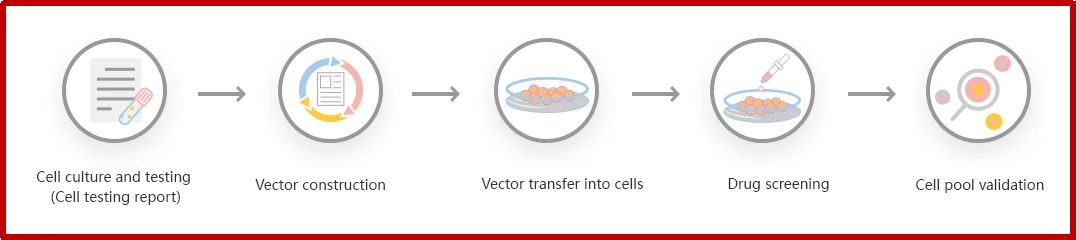
Figure: EZ-editor™ customized workflow for engineered KO cell pool
Case Study: PDXK Knockout in HepG2 Cells
To demonstrate the utility of KO pools, researchers performed a knockout of pyridoxal kinase (PDXK) in HepG2 cells using a dual-gRNA strategy. They compared the KO pool with three independently derived PDXK knockout clones.
Key Findings:
- · KO pool samples exhibited lower variability in proteomic data across replicates compared to clonal lines (Figure 1A).
- · Six significantly downregulated proteins were identified in the KO pool vs. only four in the clonal samples.
- · KO pools provided a broader and more consistent phenotypic profile, ideal for early-stage discovery studies.
Important Note: While KO pools are excellent for short-term and population-level analyses, researchers should still validate residual protein expression (e.g., via truncated isoforms or exon skipping) using mass spectrometry to rule out confounding effects.
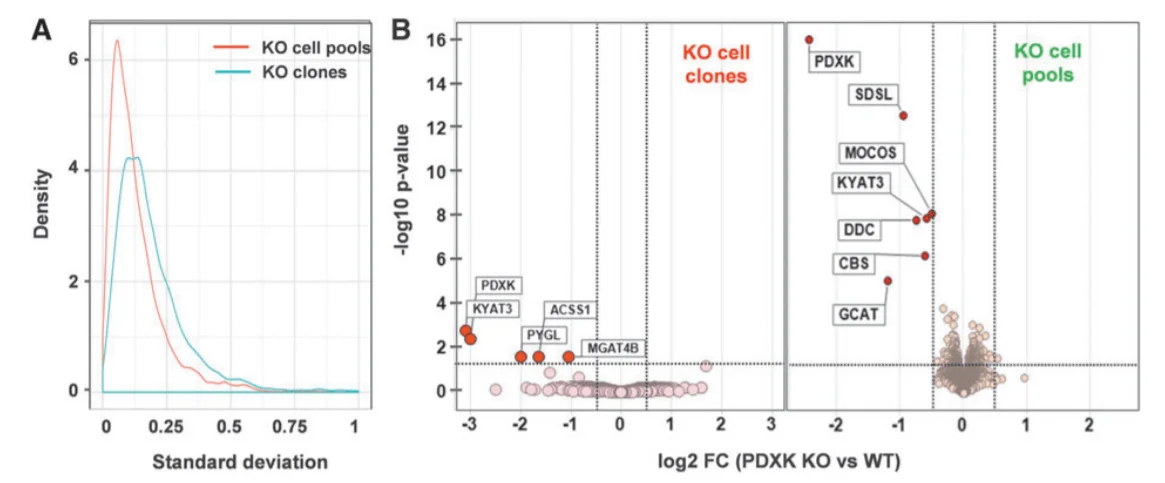
Figure. Proteomics phenotype of PDXK KO cells.
KO Pools vs. RNAi: A Superior Tool for Functional Genomics
KO pools offer a robust alternative to RNA interference for studying gene function. CRISPR-induced knockouts are more stable, specific, and comprehensive than RNAi-based knockdowns, and KO pools enable researchers to scale up early-stage experiments without sacrificing data quality or biological relevance.
Whether you're investigating drug targets, validating antibodies, or building disease models, the EZ-editor™ KO pool system offers a rapid, reliable, and customizable solution.
Read more: CRISPR vs RNAi: Why CRISPR Is the Superior Tool for Modern Genetic Research
Partner with Ubigene
Ubigene offers custom design and production of gene-edited cell lines and KO pools using the EZ-editor™ platform. From gene selection to gRNA design, delivery optimization, and validation, our team provides end-to-end solutions tailored to your research needs. Contact us today to learn how EZ-editor™ KO pools can accelerate your scientific discovery.
References
A Tandem Guide RNA-Based Strategy for Efficient CRISPR Gene Editing of Cell Populations with Low Heterogeneity of Edited Alleles. CRISPR J.2020;3(2):123-134.
 Promotions