
CRISPR Screening for Tumor Invasion Drivers in TP53-Mutant Cells

CRISPR Screening for Tumor Invasion Drivers in TP53-Mutant Cells
Research Background
TP53 is a key tumor suppressor gene that helps regulate the cell cycle, DNA damage repair, and apoptosis. Mutations in TP53 can disrupt normal cellular regulation, and some mutations can confer properties that promote tumor cell invasion. Tumor invasion typically involves changes in multiple genes. Genes that cooperate with a specific TP53 mutation to further promote invasion can be described as cooperating driver genes. Genetic screening can systematically identify candidate cooperating drivers in a defined TP53 mutant background. Gene knockout and functional assays can then help validate their roles.
A Genome-Wide CRISPR Screen Identifies Genes That Cooperate with TP53-Y234C
Research Objective
The researchers used MCF10A cells carrying the TP53-Y234C mutation as a model because these cells showed relatively low invasiveness. They used a genome-wide CRISPR knockout library to identify genes whose loss could increase invasiveness and then tested the function of the shortlisted candidates. They also investigated whether candidate gene knockout promoted invasion by activating TAZ/TEAD signaling and examined changes in upstream signaling. The aim was to identify genes that influence cell invasion in a specific TP53 mutant background and clarify how they contribute to tumor cell invasion and progression.
Research Results
Genome-wide CRISPR screening. The screen identified single-guide RNAs (sgRNAs) targeting 217 genes that were enriched more than 1,000-fold in cells recovered after invasion. Based on results from replicate screens, the functional regions targeted, patterns of co-mutation with TP53, and prior studies on cell invasion, the researchers shortlisted three genes: FGD6, GCNT1, and ADAM15.
Genomic sequencing confirmed the expected frameshift deletions in FGD6 and GCNT1. The researchers detected no effective deletion at the ADAM15 target site, so subsequent experiments focused on FGD6 and GCNT1.
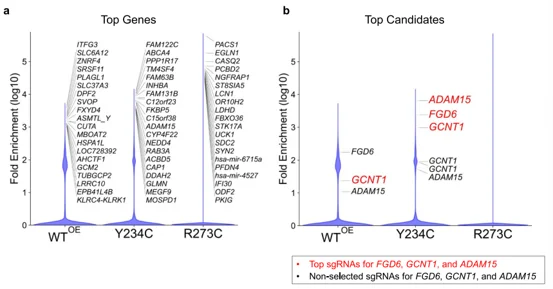
Figure 1. Genome-wide CRISPR screening identifies candidate genes associated with cell invasion across different TP53 mutant backgrounds.
Validation of candidate genes. The researchers knocked out FGD6 and GCNT1 individually in TP53-Y234C cells and assessed changes in invasiveness and related phenotypes. Loss of either gene significantly increased invasiveness compared with the parental Y234C cells, confirming the screening results.
Re-expressing FGD6 or GCNT1 in the corresponding knockout cells reduced their invasiveness, further supporting a link between loss of these genes and the invasive phenotype.
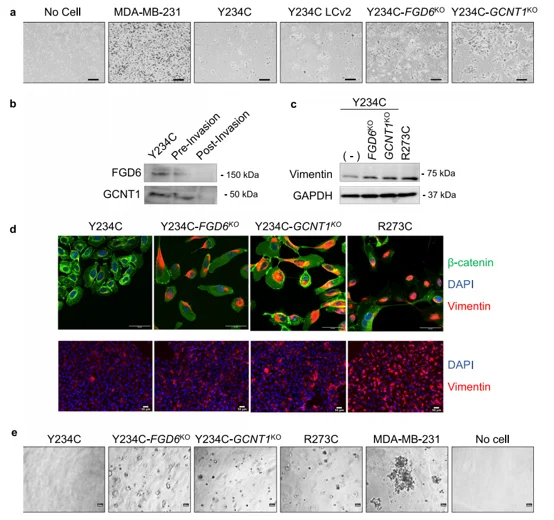
Figure 2. Knockout of FGD6 or GCNT1 increases invasiveness and alters related phenotypes in MCF10A cells carrying TP53-Y234C.
Mechanistic validation of TAZ/TEAD signaling. A TEAD luciferase reporter assay showed markedly higher TEAD transcriptional activity in both knockout cell lines. To test whether the pathway contributed to the invasive phenotype, the researchers knocked down TAZ and used a TEAD inhibitor. Both interventions markedly reduced invasiveness in FGD6- and GCNT1-knockout cells, indicating that TAZ/TEAD signaling contributes to the increased invasion associated with loss of either gene.
Further analysis of other candidates from the screen showed that, of the 145 candidate sgRNAs detected, 127 (87.6%) decreased in abundance by more than twofold after TAZ knockdown. This suggests that TAZ signaling also contributes to the invasive phenotypes associated with most of the candidates.
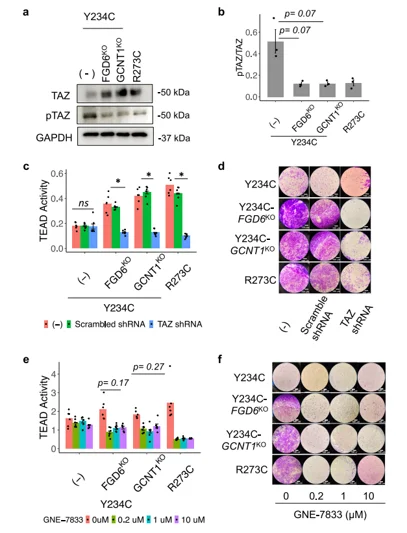
Figure 3. TAZ/TEAD signaling contributes to phenotypic changes associated with FGD6 or GCNT1 knockout.
CRISPR Screening Workflow in a Defined Mutant Background
- Establish a cell model with the mutation of interest. Choose a suitable cell type and target mutation. Generate the mutant model through gene editing or gene delivery, then verify the effect of the mutation.
- Select a CRISPR screening strategy and phenotypic readout. Choose a CRISPR knockout, CRISPR interference (CRISPRi), or CRISPR activation (CRISPRa) library based on the research question. Define the phenotype to measure, such as cell proliferation, invasion, migration, or drug sensitivity.
- Analyze screening data and identify candidate genes. Use high-throughput sequencing to compare sgRNA abundance before and after screening. Identify candidates whose guides are significantly enriched or depleted, then use functional and pathway analyses to prioritize genes for follow-up.
- Generate knockout cells and validate candidate gene function. Generate knockout cells for the candidate genes and verify knockout at the genetic and protein levels. Use phenotypic assays, gene rescue experiments, and pathway analyses to validate gene function and investigate the underlying mechanisms.
Conclusion
In cancer research, a specific mutation can interact with other genetic changes to shape cellular phenotypes. Studying an individual mutation in isolation may therefore capture only part of the mechanism underlying tumor progression. CRISPR library screening can systematically identify candidate genes associated with invasion, proliferation, migration, and drug sensitivity in a defined mutant background. Combining high-throughput sequencing with candidate gene knockout, gene rescue, and pathway analysis can help validate gene function and reveal the molecular mechanisms that govern these phenotypes. This approach can uncover key regulators within complex genetic interactions, inform research into tumor initiation and progression, and support the discovery of potential therapeutic targets.
Ubigene EZ-iScreen™ Libraries
Genome-wide CRISPR knockout screening can identify genes associated with cell invasion in a specific mutant background. The Ubigene EZ-iScreen™ platform provides end-to-end CRISPR library screening services for identifying genes associated with tumor invasion, prioritizing candidates, and investigating their functions and mechanisms. The platform supports CRISPR knockout, interference, and activation, with genome-wide libraries, pathway-focused sublibraries, and custom library design. Services cover library construction, lentiviral packaging, in vivo and in vitro screening, and next-generation sequencing (NGS).
The platform offers more than 40 plasmid libraries, more than 150 viral libraries, and more than 1,000 pooled cell libraries. These resources support screening under drug pressure to identify targets involved in tumor drug sensitization and resistance. The proprietary iScreenAnlys™ platform generates visual target analysis reports with one click, and the technical team helps evaluate study designs. Together, these services support high-throughput studies of tumor drug sensitivity, resistance mechanisms, and potential sensitization targets.
Reference
Nwachukwu, L., Pal, A., Zhang, Y. et al. Genome-wide CRISPR screen identifies mutation-specific pathways converging on TAZ/TEAD activation in mutant p53-driven breast cancer. npj Breast Cancer (2026). https://doi.org/10.1038/s41523-026-01072-2
 Promotions