
CRISPR Screen: Whole-Genome vs. CRISPR Sub-Library - Making the Right Choice

CRISPR Screen: Whole-Genome vs. CRISPR Sub-Library - Making the Right Choice
With the rapid advancement and widespread adoption of CRISPR/Cas9 technology in functional genomics, one critical decision often encountered by researchers is the selection between a whole-genome library and a sub-library for screening applications. This article provides a systematic comparison of whole-genome and sub-library CRISPR screening strategies, focusing on key parameters such as genomic coverage, screening cost, experimental throughput, and technical complexity. By dissecting the strengths and limitations of each approach across different experimental contexts — ranging from exploratory discovery to hypothesis - driven validation — to establish a decision framework for library selection tailored to specific research objectives.
We hope this discussion will assist researchers in making informed decisions when designing high-throughput CRISPR screens, and serve as a valuable reference for optimizing functional genomic studies.
CRISPR screening has emerged as a powerful tool for dissecting gene function and unraveling the genetic basis of complex phenotypes. Compared to earlier RNAi-based approaches, CRISPR/Cas9-mediated pooled sgRNA library screening offers significantly higher sensitivity and specificity, enabling precise perturbation of virtually any genomic locus [1]. In a single screen, thousands of sgRNAs targeting a broad range of genes can be delivered simultaneously into cells via lentiviral vectors, allowing for unbiased, high-throughput identification of phenotype-associated genes at a genome-wide scale. However, the extensive size of genome-wide libraries inevitably brings challenges such as increased cost, greater reagent demand, and higher experimental complexity [1]. As a result, two distinct strategies have been widely adopted: whole-genome libraries and focused sub-libraries.Are you also grappling with the question of whether to cast a wide net across the entire genome or to concentrate on a specific pathway or gene set? In this article, we first outline the definitions and core characteristics of whole-genome and sub-library designs, then systematically compare their advantages and limitations. Finally, we offer strategic recommendations based on research goals, available resources, and experimental constraints to support informed decision-making in CRISPR screening design.
Genome-Wide CRISPR Libraries
Genome-wide CRISPR libraries are designed to target all protein-coding genes of a given organism, offering the broadest possible genomic coverage. These libraries enable unbiased, hypothesis-free discovery of genes associated with a specific phenotype, making them especially valuable for exploratory studies. A notable example is the human GeCKO library (Genome-scale CRISPR Knock-Out library) developed by the Zhang lab, which targets 18,080 genes using 3 - 4 sgRNAs per gene, comprising a total of approximately 64,751 unique sgRNAs.Due to their extensive coverage, genome-wide libraries typically contain over 100,000 sgRNAs, necessitating the use of a large number of cells to maintain adequate representation during screening—commonly recommended at a minimum of 300× coverage.The primary advantage of genome-wide libraries lies in their capacity to identify novel or unexpected gene targets, minimizing the risk of false negatives and offering comprehensive insight into the genetic determinants of complex phenotypes. However, these benefits come at a significant cost. The large library size results in high synthesis and viral packaging expenses, increased cell culture, handling demands, and experimental workload. Deep sequencing and rigorous secondary validation steps are often required, making the overall workflow time- and resource-intensive [2].As such, genome-wide CRISPR libraries are generally reserved for research scenarios in which broad, unbiased genetic interrogation is essential—such as large-scale discovery screens or investigations with limited prior knowledge of pathway involvement.
CRISPR Sub-Libraries
CRISPR sub-libraries are designed to target specific functional gene sets or biological pathways, offering a more focused and manageable alternative to genome-wide libraries. These libraries typically contain sgRNAs targeting functional gene categories such as kinases, membrane proteins, signaling pathways, or disease-associated gene panels. The total number of sgRNAs in a sub-library generally ranges from several thousand to around ten thousand, significantly reducing the scale and complexity of screening experiments.Compared to whole-genome libraries, sub-libraries offer several key advantages, foremost among them being lower experimental cost and simplified workflow. Higher per-sgRNA representation can be achieved with fewer cells, leading to improved data quality and increased statistical power [2]. For example, when screening genes associated with kinases, a sub-library comprising a few thousand sgRNAs can provide high coverage without the need for extensive cell populations. Moreover, sub-libraries can be custom-designed to align with specific experimental hypotheses, which also reduces the burden of downstream validation by limiting off-target hits and false positives.However, the focused nature of sub-libraries inherently limits their coverage. By targeting only a predefined subset of genes, they are less suited for the discovery of novel or unexpected regulators and may miss functionally relevant genes outside the selected panel. As a result, sub-libraries are best suited for hypothesis-driven studies, where candidate pathways or gene families have already been implicated. While they are highly effective for targeted screening, their limitations should be carefully considered in contexts where an unbiased, genome-wide approach is needed to explore unknown biological mechanisms.
Comparative Analysis: Whole-Genome Libraries vs. Sub-Libraries
- 1. Genomic Coverage: Genome-wide libraries interrogate all annotated protein-coding genes, whereas sub-libraries cover only selected subsets, trading breadth for increased per-guide representation.
- 2. Library Size: A typical whole-genome library contains over 100,000 sgRNAs, requiring considerable time, cost, and logistical effort for synthesis, packaging, and handling. Sub-libraries are significantly smaller, usually comprising several thousand to tens of thousands of sgRNAs, which facilitates more streamlined operations.
- 3. Screening Cost: Genome-wide screens demand large cell populations, high reagent volumes, and complex downstream analysis, resulting in elevated overall costs. Sub-library screens require fewer cells and shallower sequencing depth, making them a cost-effective alternative, particularly in resource-limited settings.
- 4. Data Quality: Higher sgRNA representation per target in sub-libraries improves signal-to-noise ratios, enhancing the sensitivity and reliability of detecting sgRNA enrichment or depletion. In contrast, genome-scale libraries may suffer from lower per-sgRNA coverage, increasing the likelihood of underrepresented sgRNAs or false negatives.
- 5. Recommended Use Cases: Whole-genome libraries are best suited for large-scale, exploratory studies aimed at discovering unknown gene-phenotype associations or novel regulatory mechanisms. Sub-libraries are more appropriate for hypothesis-driven investigations, validation of candidate genes, or focused screening when experimental resources are constrained.
Key Considerations for CRISPR Library Selection
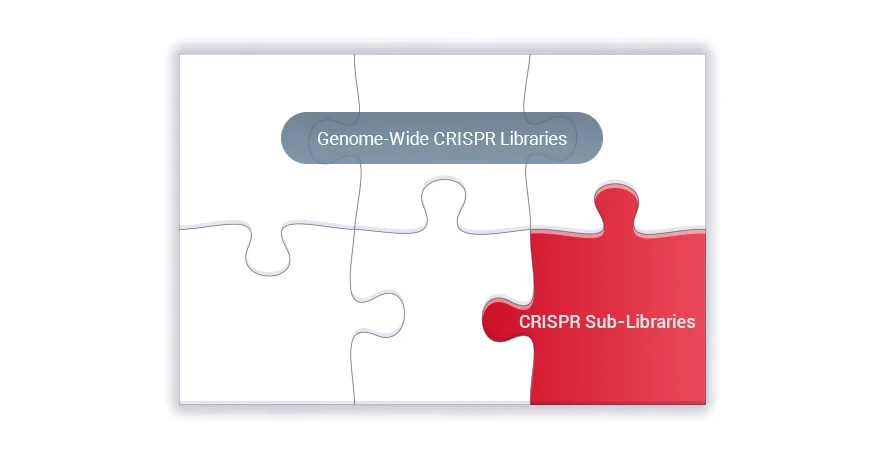
Library selection should be guided by (i) the scope of the biological question, (ii) available budget and infrastructure, and (iii) downstream data-analysis capacity.
- 1. Research Objective: A whole-genome library is preferable for exploratory studies aimed at identifying previously unknown genetic regulators or conducting the first comprehensive screen in a given context. In contrast, if the study is driven by prior biological knowledge—such as known signaling pathways or candidate gene sets—a focused sub-library is more appropriate and efficient.
- 2. Cost and Timeline: Whole-genome screens are resource-intensive, requiring substantial investment in cell culture, viral packaging, next-generation sequencing, and time. Sub-libraries, on the other hand, offer a cost-effective and time-efficient alternative, making them suitable for projects with limited funding or tighter timelines.
- 3. Technical Resources: Effective whole-genome screening necessitates access to Cas9-stable cell lines, large-scale culture capacity, and high-throughput sequencing infrastructure. Laboratories with constrained technical resources may benefit from using sub-libraries, which require fewer cells, less virus, and reduced dependence on specialized equipment.
- 4. Data Analysis: Whole-genome screens generate vast datasets that require sophisticated bioinformatic pipelines and extensive validation of hits. Sub-library screens produce more focused and manageable datasets, facilitating faster signal detection and interpretation.
- 5. Experimental Flexibility: Sub-libraries provide greater flexibility for iterative screening and protocol optimization, as they can be rapidly customized to target different gene subsets. In contrast, genome-wide libraries are less adaptable once constructed and deployed.
In sum, the optimal library format is context-dependent; researchers must balance discovery breadth against experimental constraints to maximize screening efficiency and biological insight. For exploratory studies requiring comprehensive, unbiased interrogation of the genome, whole-genome libraries offer unparalleled discovery potential. In contrast, for pathway-focused investigations or experiments constrained by resources, sub-libraries provide a more efficient and targeted approach. Ultimately, selecting the appropriate library format is a strategic decision that should align with the specific goals, capabilities, and constraints of the research project.
Conclusion
The selection of an appropriate CRISPR screening library involves a multidimensional decision-making process, factoring in genomic coverage, experimental scale, cost, and discovery potential. By clearly defining research objectives, assessing available resources, and leveraging existing library designs as references, researchers can make informed choices between whole-genome and sub-library strategies. We hope this overview provides valuable insights to support more efficient and targeted CRISPR screening, while maintaining scientific rigor.
Ubigene currently offers a portfolio of over 400 Screening-ready Cell Pool, including both whole-genome and pathway-focused sub-libraries, designed to meet diverse experimental needs. Ubigene also provides end-to-end CRISPR screening support services — from library construction to data analysis—helping you accelerate discovery and streamline your functional genomics workflow with confidence.
Contact us to get started>>
Reference
1.Liu C, Li Z, Zhang Y. [Application Progress of CRISPR/Cas9 System for Gene Editing in Tumor Research]. Zhongguo Fei Ai Za Zhi. 2015 Sep 20;18(9):571-9. Chinese. doi: 10.3779/j.issn.1009-3419.2015.09.08. PMID: 26383982; PMCID: PMC6000117.
2.Lei T, Xiao B, He Y, Qu J, Sun Z, Li L. [Development and applications of CRISPR/Cas9 library screening technology in cancer research]. Nan Fang Yi Ke Da Xue Xue Bao. 2019 Nov 30;39(11):1381-1386. Chinese. doi: 10.12122/j.issn.1673-4254.2019.11.18. PMID: 31852637; PMCID: PMC6926087.
 Promotions