
New breakthrough in point mutation technology | Ubigene



Case Study
Progress in the Nature Series | Precision Base Editing Shows Promise: Prime Editing Restores Retinal Function in Blind Mice
Retinitis pigmentosa (RP) is the most common form of inherited retinal degeneration, with a global prevalence of approximately 1 in 4,000. It is characterized by the early degeneration of rod photoreceptors (responsible for scotopic/low-light vision), followed by cone photoreceptor loss (mediating color and photopic/bright-light vision). Patients typically develop nyctalopia during adolescence, progressive constriction of peripheral visual fields in early adulthood, and eventually central vision loss. To date, there is no curative treatment available.
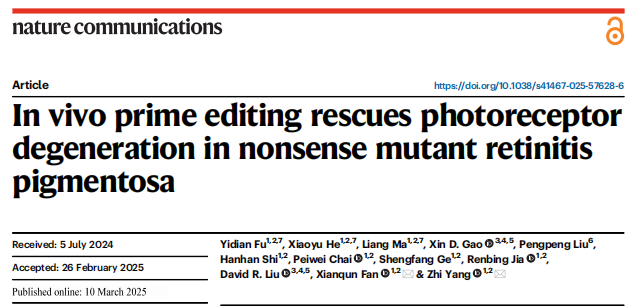
On March 10, 2025, a collaborative research team led by Prof. Xianqun Fan from the Department of Ophthalmology, Ninth People’s Hospital affiliated with Shanghai Jiao Tong University School of Medicine, and Prof. David R. Liu from Harvard University, published their latest findings in Nature Communications. Targeting nonsense mutation-associated RP, the investigators developed a dual-AAV–delivered prime editing system incorporating epegRNA and a modified reverse transcriptase (RT^ΔRnH). In the classical RP mouse model rd1, this approach achieved a targeted editing efficiency of 26.47 ± 13.35%, with no significant off-target effects validated by AID-Seq and PE-tag assays. The treatment successfully restored PDE6B protein expression to 39% of wild-type levels, protected rod photoreceptors from degeneration, and demonstrated significant functional rescue based on electroretinography (ERG), light–dark box assays, and additional behavioral evaluations. These results highlight prime editing as a promising genome-level therapeutic strategy for inherited RP.
I. Research Background
1. Retinitis Pigmentosa (RP)
RP exhibits high genetic heterogeneity. Its inheritance patterns are primarily categorized into three types: autosomal recessive RP (arRP, ~40%), autosomal dominant RP (adRP, ~25%), and X-linked RP (XLRP, ~15%), with the remaining ~20% representing sporadic cases. To date, over 70 causative genes and more than 3,000 genetic variants have been identified (data from the RetNet database), affecting key physiological processes including phototransduction, the visual cycle, and photoreceptor cell structural maintenance. Among these, the PDE6B gene (OMIM 180072) is one of the major causative genes for arRP, and its mutations directly lead to rod photoreceptor dysfunction and apoptosis.

Figure 1
2. Prime Editing (PE)
As a next-generation precise genome editing technology, prime editing (PE) offers several advantages: it does not require double-strand breaks (DSBs), enables precise single-base substitutions (not limited to A>G or C>T), avoids large-scale DNA damage, and exhibits higher safety. PE is compatible with a broader range of cell types and applications, including hard-to-edit cell lines.
The prime editing system mainly consists of two components:
● A fusion protein composed of a DNA nickase (Cas9 nickase, nCas9) and an engineered reverse transcriptase (RT).
● A prime editing guide RNA (pegRNA).
The pegRNA is derived from a standard single-guide RNA (sgRNA) with an extended 3’ sequence that serves dual functions: one end acts as a primer binding site (PBS) for reverse transcription, while the other end functions as a reverse transcriptase template (RTT), which carries the designed target point mutation or insertion/deletion mutation for editing.
Ⅱ. Research Design and Methods
1. Optimization of the PE System and Vector Construction
● Core component improvements:
① epegRNA: Based on conventional pegRNA, a 3’ RNA structural motif was added to protect the 3’ extension from degradation, thereby enhancing editing efficiency.
② RT^ΔRnH: A reverse transcriptase with a truncated RNase H domain (~0.6 kb), which retains comparable functionality to the full-length RT while reducing vector size, making it compatible with AAV delivery.
③ Vector system: A dual AAV2 vector strategy was employed to overcome the size limitation of a single AAV (~4.8 kb) for the PE system (~6.3 kb), with strong retinal tropism:
| AAV Vector Type | Cargo | Function |
|---|---|---|
| AAV2-PE-N | epegRNA, sgRNA, N-terminal portion of nCas9 (aa 1–713) | Provides guide RNA and partial Cas9 fragment |
| AAV2-PE-C | C-terminal portion of nCas9 (aa 714–1368), RT^ΔRnH | Provides remaining Cas9 fragment and truncated reverse transcriptase |
● In vitro screening:
The team used PE-Designer, pegIT, and PrimeDesign to design pegRNA and nsgRNA targeting the Pde6b Y347X mutation. Four candidate combinations were randomly selected from each tool, yielding 12 candidate pairs (pn1–12). The editing goal of the PE system was to correct the mutated A base to a C base at the target site, thereby restoring normal translation of PDE6B protein.

Figure 2
2. In Vivo Experimental Workflow
● Injection protocol: At postnatal day 7 (prior to disease onset), rd1 mice received subretinal injections of the dual AAV mixture (1 μL; AAV2-PE-N and AAV2-PE-C mixed 1:1). The procedure did not cause significant vitreous hemorrhage or retinal detachment.
● Assessment time points: Four weeks post-injection (at 5 weeks of age, when untreated rd1 mice exhibit near-complete rod photoreceptor loss), molecular, morphological, and functional evaluations were performed.
● Off-target validation: The safety of the PE system was confirmed using AID-Seq (an in vitro off-target detection method with reduced false positives) and PE-tag (a state-of-the-art genome-wide off-target detection technology).
Ⅲ. Research Results
● In vitro screening of high-efficiency pegRNA/nsgRNA combinations
The researchers constructed a reporter plasmid containing exon 7 of Pde6b (wild-type or mutant), a 3×Flag tag, and EGFP. Flag and EGFP signals were detectable only when PE successfully corrected the stop codon, providing a visual readout for screening. The reporter plasmid (including mScarlet to indicate transfection efficiency) was co-transfected with PE system plasmids (prime editor + pn1–12) into 293T cells. Forty-eight hours post-transfection, editing efficiency was evaluated using four methods, including Western blot and immunostaining. Western blot results showed that the pn4 group exhibited significantly higher PDE6B-Flag protein expression than the other groups, indicating that this guide RNA combination had the highest efficiency. Quantification of the GFP signal ratio (GFP/mScarlet) revealed that the pn4 group had a significantly higher relative GFP ratio compared with the other pn groups (***p < 0.001), further confirming its editing efficiency. Deep sequencing demonstrated an in vitro editing efficiency of 27.96 ± 6.27% in the pn4 group (***p < 0.001). Based on these results, pn4 was selected as the optimal guide RNA combination for subsequent in vivo experiments.

Figure 3
● Precise in vivo editing and photoreceptor protection by the PE system in rd1 mice
The PE system was split into AAV2-PE-N (containing epegRNA, sgRNA, and the N-terminal portion of nCas9) and AAV2-PE-C (containing the C-terminal portion of nCas9 and RT^ΔRnH), which underwent in vivo trans-splicing recombination to reconstitute full-length PE, overcoming the AAV packaging limit (~4.8 kb).
Subretinal injections of the dual AAVs were performed in postnatal day 7 rd1 mice, and functional and molecular analyses were conducted at 5 weeks of age (4 weeks post-injection), when untreated rd1 mice exhibit near-complete rod photoreceptor degeneration. Deep sequencing revealed a targeted A→C conversion efficiency of 26.47 ± 13.35% in the PE-treated group (*p < 0.05, ***p < 0.001), with no detectable unintended base changes, confirming high editing precision. Western blot analysis showed that PDE6B protein expression in the PE-treated group was restored to 39% of wild-type levels, whereas untreated rd1 mice lacked detectable PDE6B, demonstrating successful restoration of the target protein.
Immunofluorescence staining using anti-rhodopsin antibodies revealed significant survival of rod photoreceptors (red signal) in the PE-treated retina. The outer segment (OS) thickness reached 20.48 ± 2.69 μm, significantly higher than in untreated mice (**5.00 ± 0.99 μm, p < 0.01). Hematoxylin & eosin (HE) staining further confirmed that the outer nuclear layer (ONL, containing photoreceptor nuclei) in PE-treated mice retained four layers of nuclei (approximately 50% of wild-type thickness), whereas untreated mice retained only one incomplete layer, demonstrating that PE markedly delays photoreceptor degeneration.

Figure 4
● In vivo assessment of off-target effects of the PE system
To minimize false positives and precisely predict potential off-target sites of peg4/nsg4, the researchers employed AID-Seq with hairpin i7 and biotinylated i5 adapters. AID-Seq identified three potential off-target sites for peg4 (e.g., chr10:87264608–87264631) and two potential off-target sites for nsg4 (e.g., chr9:57564452–57564475). All sites were located in intergenic regions or introns, without overlap with essential functional genes.
Deep sequencing revealed that the indel rates at these potential off-target sites in PE-treated mice were not significantly different from untreated rd1 mice (ns). Combined with PE-tag analysis, which showed high editing activity only at the target site, these results confirm that the PE system exhibits negligible off-target effects in vivo.

Figure 5
● Regulation of retinal phototransduction–related gene expression by the PE system
Compared with wild-type mice, rd1 retinas exhibited significant downregulation of phototransduction pathways. Following PE treatment, these pathways were markedly upregulated (FDR < 0.05), indicating that PE can restore retinal functional pathways. Specifically, phototransduction-related genes such as Pde6b and Cnga1 were significantly downregulated in rd1 mice, while PE treatment led to a significant recovery of their expression (|log₂(FC)| > 1, p < 0.05).
Moreover, mRNA levels of rod-specific genes (Pde6b, Cnga1, Rho), cone-specific genes (Arr3, Opn1mw), phototransduction genes (Rbp3, Grk1), and retinal ganglion cell (RGC) regeneration–associated genes (Cryga, Cryge) were all significantly higher in the PE-treated group compared with untreated rd1 mice. These results confirm that PE can comprehensively restore expression of genes critical for retinal function.

Figure 6
● Restoration of visual function in rd1 mice by the PE system
To assess recovery of visual function, the authors first measured pupillary light reflexes. Untreated rd1 mice exhibited weak pupil constriction due to photoreceptor loss, whereas PE-treated mice showed significantly increased pupil constriction (*p < 0.001), approaching wild-type levels, confirming restoration of light responsiveness.
Leveraging mice’s natural preference for dark environments, the time spent in the dark zone was evaluated. Untreated rd1 mice spent 149.80 ± 16.88 s in the dark zone, significantly lower than wild-type mice (224.00 ± 17.75 s). PE-treated mice spent 194.00 ± 23.60 s (**p < 0.01 vs untreated), indicating recovery of visually mediated innate behavior.Mice also exhibit an innate avoidance of a “visual cliff” (simulated height), allowing assessment of spatial visual function. Untreated rd1 mice showed no difference in time spent on the cliff side versus the bench side (159.00 ± 18.74 s on cliff), reflecting impaired visual discrimination. In contrast, PE-treated mice spent 129.80 ± 9.15 s on the cliff side (*p = 0.036 vs untreated), approaching wild-type behavior (95.83 ± 23.65 s), demonstrating restoration of spatial vision.
Importantly, PE-treated mice maintained near–wild-type performance in the light–dark box at 8 weeks post-treatment (dark zone time: 191.80 ± 27.47 s, **p = 0.008 vs untreated), confirming the durability of the therapeutic effect.

Figure 7
Ⅳ. Significance of the Study
1. Technical Feasibility: The study successfully established a dual AAV–delivered PE system carrying epegRNA and RT^ΔRnH, achieving 26.47 ± 13.35% precise editing efficiency in rd1 mice. Off-target analyses using AID-Seq and PE-tag confirmed no significant off-target effects, demonstrating the safety and efficacy of the PE system in the eye.
2. Molecular and Morphological Rescue: The PE system restored PDE6B protein expression to 39% of wild-type levels and protected rod photoreceptors from degeneration. The outer nuclear layer (ONL) thickness reached approximately 50% of wild-type, with significant improvement in photoreceptor structure.
3. Functional Recovery: Multidimensional assessments—including electroretinography (ERG), pupillary light reflex, and behavioral tests—demonstrated that PE treatment significantly restored scotopic vision, light responsiveness, and visually mediated innate behaviors in rd1 mice. The therapeutic effect was durable for at least 8 weeks.
4. Clinical Implications: This study provides the first evidence that PE can correct a PDE6B nonsense mutation in an RP model, offering a novel genome-level therapeutic strategy for inherited RP. Furthermore, the dual AAV-PE system design establishes a reusable technical framework for gene editing of other ocular genetic disorders.
Application: EZ-HRex™ Precision Point Mutation Technology
Building on its existing platform, Ubigene has innovatively introduced U+ molecules, upgrading the system to EZ-HRex™ precision point mutation technology. Post-upgrade, HDR efficiency for point mutations and fragment knock-ins has increased substantially, with HDR efficiency ratios reaching up to 84%, significantly improving success rates and reducing project timelines.
The platform supports RNP, PE, BE, and plasmid resistance screening strategies, is compatible with diverse cell types and complex genomic loci, and enables delivery of positive clones in as little as 6 weeks. Project pricing starts from $6,480, providing a highly efficient solution for challenging genome editing projects.
Contact us for more technical support>>
Reference
Fu Y, He X, Ma L, Gao XD, Liu P, Shi H, Chai P, Ge S, Jia R, Liu DR, Fan X, Yang Z. In vivo prime editing rescues photoreceptor degeneration in nonsense mutant retinitis pigmentosa.
Nat Commun. 2025 Mar 10;16(1):2394. doi: 10.1038/s41467-025-57628-6. PMID: 40064881; PMCID: PMC11893901.
 Promotions