
Struggling with Transfection? Let Lentiviral Infection Come to the Rescue!


Gene Editing Practical Tips
Struggling with Transfection? Let Lentiviral Infection Come to the Rescue!
In biological research, suspension cells (such as immune cells and lymphocytes) serve as ideal models owing to their ability to closely recapitulate the physiological characteristics of the in vivo microenvironment. They are widely used for investigating cooperative responses among immune cells as well as signaling interactions between stem cells and their niches. However, their intrinsic properties—constant suspension, tendency to aggregate, and negatively charged cell surfaces—pose major challenges for gene delivery. Conventional chemical transfection or electroporation methods often result in extremely low or even negligible efficiency.
Here, Ubigene highlights the key advantages of lentiviral transduction and provides practical strategies to help researchers overcome these barriers, thereby enabling efficient and reliable manipulation of suspension cells.
Why Is Lentiviral Infection the “Method of Choice” for Suspension Cells?
Lentiviral transduction is a gene-editing approach that employs lentiviruses (a subclass of retroviruses) as vectors to deliver exogenous genes into target cells. Once inside the cell, the viral RNA is reverse-transcribed into DNA and subsequently integrated into the host genome, enabling stable and long-term expression of the introduced gene.
1. Relatively High Infection Efficiency
Lentiviruses can actively infect a wide range of cell types without relying on adherence. Even notoriously hard-to-transfect suspension cells such as Jurkat, THP-1, and Raji can be efficiently transduced.
2. Stable Genomic Integration
The viral genome integrates stably into host chromosomes, ensuring long-term and consistent expression of the target gene. This makes lentiviral systems particularly well-suited for experiments requiring sustained manipulation, such as gain- or loss-of-function studies and the generation of stable cell lines.
3. Low Cytotoxicity
Compared with electroporation, viral delivery causes minimal physical damage to suspension cells, providing a gentler and more cell-friendly environment for genetic manipulation.
4. High Cargo Capacity
Lentiviral vectors can accommodate relatively large genetic inserts (up to ~8 kb), surpassing the limits of many conventional plasmid vectors. This feature is especially advantageous for constructing complex expression cassettes—for example, those combining fluorescent tags with selectable markers.
A Step-by-Step Guide to Lentiviral Transduction of Suspension Cells
The high efficiency of lentiviral transduction in suspension cells relies on several key steps. It begins with the production of high-quality viral particles, followed by titer determination and optimization of the multiplicity of infection (MOI) to identify the most suitable infection conditions. The virus is then introduced into the target cells, after which appropriate selection and validation are performed. Each step is closely interconnected, and only through this systematic design can stable expression of the transgene be achieved while maintaining the health of suspension cells—ensuring more reliable transduction outcomes.
Key Operational Considerations
Lentiviral transduction offers significant advantages in suspension cell systems. However, to further ensure experimental stability and reproducibility, precise attention to procedural details is essential. By mastering the following five steps, even beginners can get started with confidence.
Step 1. Maintain Cells at Their “Peak Condition”
The cell condition of suspension cells directly determines the success of infection. Keep a close eye on these 3 factors:
- · Cell viability above 85% ensures more reliable transduction.
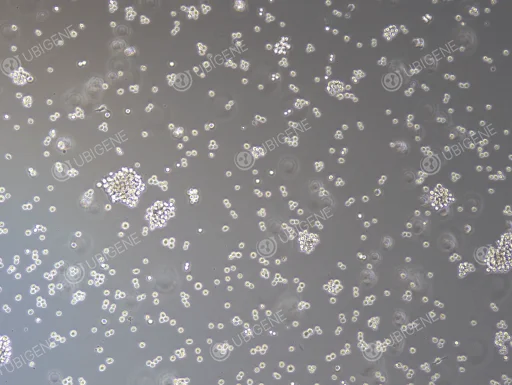
- · Healthy morphology is a good sign—cells should appear round and bright. For cell types prone to clumping, examine the outer layer of the aggregates; a glossy appearance often indicates good condition (see image below).
- · Optimal density adjustment before infection: dilute to 2×10⁵–5×10⁵ cells/mL, as cells in the logarithmic growth phase are the most responsive to transduction.
Step 2. Fine-Tune the Infection System
This step is crucial for maximizing transduction efficiency. Three key parameters need careful optimization:
- · Multiplicity of Infection (MOI):
Higher is not always better. It is recommended to perform a gradient experiment and select the condition that gives the strongest fluorescence signal.
- · Use of Enhancers (e.g., Polybrene):
Acts like a “bridge” between the virus and cells. A concentration of 5–10 μg/mL is typically ideal. Always prepare with PBS and filter-sterilize before use.
- · Spinoculation (Centrifugal Infection):
A secret to doubling efficiency. Centrifuge at 800–1200 × g for 30–90 minutes at room temperature (adjust according to cell tolerance). The centrifugal force helps the virus and cells make closer contact.
Step 3. Careful Post-Infection Handling
- · Replace with fresh medium 12–24 hours post-infection: This removes residual virus and Polybrene, minimizing cytotoxic effects.
- · Gentle culture medium change: Retain about half of the old medium to avoid cell stress or damage from centrifugation during the medium replacement.
Step 4. Selection and Validation: Mission Accomplished
Adjust selection conditions flexibly. If fluorescence signals remain weak 24–48 hours post-transduction, consider extending the infection duration or lowering the concentration of the selection agent to reduce cellular stress.
Pitfall Guide: Mistakes to Avoid
- · Using virus withlowtiter: This is essentially a wasted effort—low viral concentration rarely leads to successful transduction.
- · Ignoring cell condition: Never start the experiment if cell viability is below 80%.
- · Vigorously shaking plates after centrifugation: Newly adsorbed viruses can detach easily, drastically reducing efficiency.
- · Selecting antibiotic concentration by guesswork: Always perform a gradient pre-test to determine the optimal selection conditions.
Conclusion
Lentiviral transduction is like providing a “customized delivery service” for suspension cells. By carefully controlling cell condition, MOI, and centrifugation parameters, even hard-to-transfect cells can be efficiently targeted.
If you encounter bottlenecks in cell transfection, stable cell line generation, or related experiments, feel free to reach out to Ubigene for one-stop technical support and supercharge your research efficiency!
 Promotions