NLRP3 R262W THP-1 Cells for Inflammasome Activation Research

The NLRP3 inflammasome is a central sensing complex in the innate immune system that assembles and becomes activated in response to diverse cellular stress signals. Aberrant NLRP3 activation is closely associated with autoinflammatory diseases, including cryopyrin-associated periodic syndromes (CAPS). R262W is a CAPS-associated gain-of-function mutation in NLRP3 that promotes abnormal inflammasome activation. Studies have shown that THP-1 cells carrying this mutation can activate the inflammasome following stimulation with LPS or Pam2CSK4 without an additional second signal, providing a cellular model for investigating mechanisms of aberrant NLRP3 activation [1]. This article introduces the research value of NLRP3 R262W THP-1 cells, common experimental approaches, and representative applications.
1. NLRP3 Links Innate Immunity to Inflammatory Responses
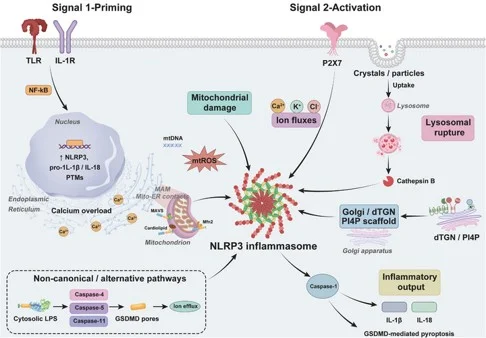
Persistent, dysregulated inflammation causes tissue damage and contributes to various autoinflammatory diseases. As a central sensing complex in innate immunity, the NLRP3 inflammasome detects cellular stress signals and mediates caspase-1 activation, the maturation and release of IL-1β and IL-18, and pyroptosis through gasdermin D (GSDMD) cleavage [3].
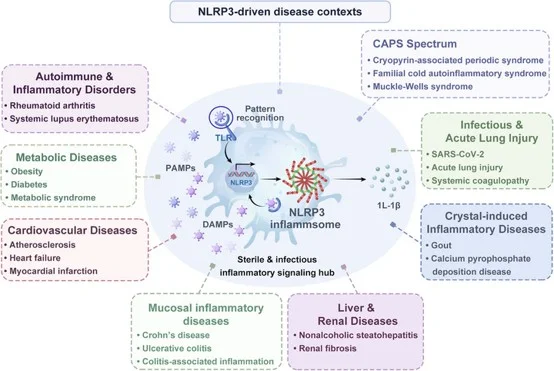
Under normal conditions, this process helps the body defend against pathogens and respond to cellular damage. However, excessive inflammasome activation caused by NLRP3 dysregulation contributes to pathological processes in autoinflammatory and metabolic diseases, among other conditions [2].
2. NLRP3 Mutations Promote Aberrant Inflammasome Activation and Autoinflammatory Disease
Cell models carrying specific mutations allow researchers to connect genetic variants with changes in inflammasome function and investigate disease mechanisms and potential therapeutic strategies.
The main research applications of NLRP3 R262W THP-1 cells include the following [2,4]:
Disease mechanism studies: NLRP3 R262W is a CAPS-associated gain-of-function mutation. This model enables researchers to investigate how the variant affects inflammasome activation and downstream inflammatory responses, helping elucidate the mechanisms underlying autoinflammatory disease.
Functional genetic screening: CRISPR library screening combined with functional validation can identify key genes that influence mutation-associated inflammatory phenotypes, define the regulatory network of the NLRP3 inflammasome, and reveal potential intervention targets.
Drug discovery and development: Screening and functional evaluation of candidate compounds can reveal their effects on inflammasome activation and downstream inflammatory responses, providing experimental evidence to support anti-inflammatory strategies.
3. Common Research Approaches Using NLRP3 Mutant Disease Models
Studies of NLRP3 R262W can proceed along two complementary lines: phenotypic validation and functional screening.
Approach 1: Validate the Effects of the Mutation on Inflammasome Activation [5]
Compare inflammation-related phenotypes in wild-type THP-1 cells and NLRP3 R262W mutant cells. Common readouts include inflammatory cytokine release, inflammasome activation, pyroptosis, cell morphology, and cell viability. These measurements provide an initial assessment of whether the mutation alters the activation state of the inflammasome.
Approach 2: Screen Functional Genes and Validate Intervention Targets [6]
From genes to function: Use R262W cells for CRISPR-Cas9 gene knockout experiments or genome-wide library screening to identify candidate genes that enhance or suppress inflammation-related phenotypes. Subsequent functional validation can further define the regulatory network of the NLRP3 inflammasome and identify potential intervention targets.
From compounds to targets: Use R262W mutant cells to evaluate whether candidate compounds reduce abnormal inflammatory responses. Distinguish between direct inhibition of the NLRP3 inflammasome, inhibition of upstream priming signals, and indirect reductions in inflammatory readouts caused by decreased cell viability. For disease-associated mutations, comparing compound effects in wild-type and mutant cells can provide additional insight.
4. Application Case Studies
Case Study 1: Genome-Wide CRISPR Screening Reveals New Mechanisms Regulating the NLRP3 Inflammasome
In a study published in Cell Research in 2025, Zou et al. performed a genome-wide CRISPR-Cas9 screen using THP-1 cells carrying a heterozygous NLRP3 R262W gain-of-function mutation [1]. In this model, LPS or Pam2CSK4 stimulation can activate the inflammasome without an additional second signal. The screen identified candidate regulators, including genes associated with the NF-κB pathway, ZDHHC7, which mediates palmitoylation, and ABHD13, which mediates depalmitoylation. Further investigation revealed the molecular mechanisms through which NLRP3 palmitoylation regulates phase separation and inflammasome activation.
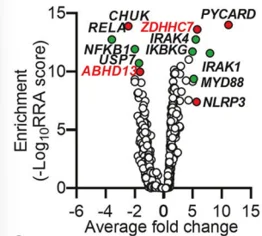
This study demonstrates the value of disease-associated mutant cell models for investigating inflammatory mechanisms. These models enable researchers to characterize mutation-associated inflammatory phenotypes, identify regulators of aberrant activation through genome-wide CRISPR screening, and progressively elucidate the underlying molecular mechanisms through follow-up experiments.
Case Study 2: 4-Octyl Itaconate Inhibits Constitutive Activation of CAPS-Associated NLRP3 Mutants
Resistance and adverse reactions to IL-1 blockers in patients with CAPS highlight the need for new therapeutic strategies. Molina-Lopez et al. (Cellular and Molecular Life Sciences, 2025) evaluated the inhibitory effects of the itaconate derivative 4-octyl itaconate (4-OI) in CAPS-associated NLRP3 models carrying the p.R262W, p.D305N, and p.T350M variants [5]. The study found that 4-OI effectively blocked basal, constitutive inflammasome activation driven by R262W and other variants, inhibiting caspase-1 activation, gasdermin D cleavage, and IL-18 release. Following LPS priming, 4-OI also reduced IL-1β gene expression and release.
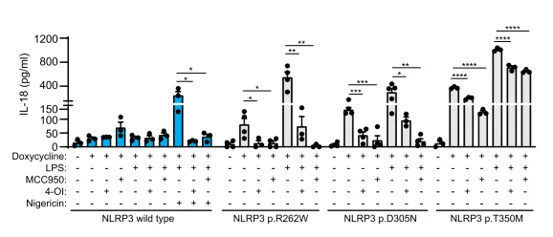
These findings demonstrate that CAPS-associated NLRP3 mutant models can be used to evaluate how candidate compounds modulate aberrant inflammasome activation.
Research implications: Together, these case studies illustrate the potential of the R262W THP-1 cell model for genetic screening and compound evaluation. From CRISPR library screening to candidate gene validation, and from phenotypic compound screening to mechanistic analysis, disease-associated mutant cell models provide a starting point for a complete research workflow connecting phenotypic observations with mechanistic understanding.
Custom Gene Editing Services for Inflammation Research
Using its proprietary EZ-HRex™ technology, Ubigene offers custom cell line services for introducing precise point mutations into key inflammatory regulatory genes, including NLRP3. These services help researchers establish cell models carrying CAPS-associated mutations and investigate the relationships between genetic variants, inflammasome activation, and pyroptosis. EZ-HRex™ technology improves homology-directed repair efficiency and facilitates the generation of point mutations in immune cells, supporting the screening of positive clones. Ubigene also provides gene knock-in, stable overexpression, and other gene editing services to support candidate gene validation, disease model development, and research into inflammatory mechanisms.
References
[1] Zou, Gonglu et al. “Signal-induced NLRP3 phase separation initiates inflammasome activation.” Cell research vol. 35,6 (2025): 437-452. doi:10.1038/s41422-025-01096-6
[2]Zou, Chan et al. “The NLRP3 Inflammasome: Mechanisms of Activation, Regulation, and Therapeutic Opportunities.” MedComm vol. 7,3 e70660. 5 Mar. 2026, doi:10.1002/mco2.70660
[3] Weber, Alexander N R et al. “The expanding role of the NLRP3 inflammasome from periodic fevers to therapeutic targets.” Nature immunology vol. 26,9 (2025): 1453-1466. doi:10.1038/s41590-025-02230-7
[4]Booshehri, Laela M, and Hal M Hoffman. “CAPS and NLRP3.” Journal of clinical immunology vol. 39,3 (2019): 277-286. doi:10.1007/s10875-019-00638-z
[5] Molina-Lopez, Cristina et al. “4-octyl itaconate reduces human NLRP3 inflammasome constitutive activation with the cryopyrin-associated periodic syndrome p.R262W, p.D305N and p.T350M variants.” Cellular and molecular life sciences : CMLS vol. 82,1 209. 23 May. 2025, doi:10.1007/s00018-025-05699-5
[6]Gao, Hui et al. “Genome-wide screen based on 2DG activated NLRP3 inflammasome reveals the priming signal of TLR2/4 to IKKβ but not IKKα.” International immunopharmacology vol. 145 (2025): 113781. doi:10.1016/j.intimp.2024.113781
 Promotions