
Still wondering why your manuscripts face repeated rejections? Have you ensured that your stable cell lines are derived from single clones?


In experimental research, even the most carefully designed studies rely on reproducibility and the stability of the underlying experimental system. Many researchers dedicate considerable time and effort, only to find that fluctuations in their data undermine the reliability of their conclusions. These variations are not necessarily caused by experimental procedures themselves; rather, they often stem from the state of the foundational materials. For example, relying solely on a mixed cell pool instead of well-characterized Stable cell lines can introduce significant variability. The critical issue is not the experiment itself, but whether the cellular background is sufficiently stable to support long-term, reproducible studies. This raises a key consideration for researchers: are your stable cell lines truly stable, and have you carefully selected single clones to ensure consistent and reliable experimental outcomes?
1.Stable Cell Lines: From Concept to Research Value
A stable cell line refers to a cell population in which a target gene has been engineered to achieve long-term, consistent expression or suppression, providing a reliable and sustainable experimental material for research. Common approaches for generating stable cell lines include lentiviral systems, transposon-based systems, and proprietary genome engineering technologies developed by companies such as Ubigene. These methods enable the integration of the gene of interest into the host genome, creating a stable genetic framework for subsequent studies.
Compared with transient transfection, stable cell lines maintain uniform expression over extended periods without the need for repeated transfection, which not only reduces experimental costs but also enhances the reliability of experimental outcomes. They are particularly well-suited for long-term studies, including functional validation, mechanistic investigations of drug action, and analyses of protein structure and dynamics. Moreover, the expression profile of the target gene in stable cell lines is often closer to physiological levels, avoiding the transient expression peaks that can distort data and making experimental results more robust and reproducible.
In addition, stable cell lines offer considerable versatility and scalability. They are widely applicable in protein production, cell therapy development, antibody manufacturing, and vaccine research. For researchers aiming to obtain consistent, reproducible data, establishing stable cell lines has become an essential component of modern biomedical research, providing a foundation for higher experimental efficiency and improved manuscript quality.
2.When Stable Cell Lines Are Essential: The “Must-Have” in Research
In many research scenarios, stable cell lines are not merely an optional tool—they are often critical for experimental success. For studies examining long-term gene function or regulatory mechanisms, whether in the context of chronic disease models, pathway activation or inhibition, or tumor gene function analysis, stable cell lines provide a consistent and reproducible expression background. This reduces experimental variability and ensures that research conclusions are more robust and reliable.
When the target gene has specific functions or potential toxicity, inducible expression systems such as Tet-on/Tet-off can be combined with stable cell lines to precisely control gene expression in a temporal and spatial manner. This approach not only enhances experimental safety but also improves data interpretability, making it particularly valuable for studies involving housekeeping or lethal genes.
For experiments requiring long-term gene suppression, such as knockdown using shRNA or miRNA, stable knockdown cell lines can maintain uniform and persistent inhibition, significantly improving data reliability and reproducibility. Compared with transient knockdown approaches, this strategy offers clear advantages for long-term experiments and complex mechanistic studies.
Furthermore, stable cell lines are indispensable for applications such as drug screening, recombinant protein production, antibody manufacturing, and vaccine antigen preparation. Their high stability and uniformity make them ideal for scalable experiments and industrial applications, providing researchers and production teams with a stable, controllable platform for consistent experimental outcomes.
3.Cell Pool vs. Single Clone: A Key Factor in Manuscript Success
In research practice, many experiments still rely on mixed cell pools (cell pools). While using pools allows for rapid generation of preliminary data, this approach has inherent limitations. Within a pool, individual cells can exhibit heterogeneous gene expression, which may fluctuate over time and with successive passages. As a result, experimental data can be variable and less reproducible. To maintain a high proportion of cells with strong expression, researchers often need to perform continuous selection, which increases operational complexity and may further compromise data consistency. These fluctuations can lead to inconsistent results, increasing the risk of manuscript rejection during peer review.
In contrast, Stable cell lines provide a far more consistent and reliable experimental foundation. Clones derived from single cells exhibit uniform and long-term stable expression of the target gene, improving the accuracy and reproducibility of quantitative experiments. Single-clone stable lines are particularly advantageous in applications requiring high precision, such as mechanistic studies, antibody production, and vaccine development. By ensuring greater consistency and reliability, single-clone approaches not only enhance the robustness of experimental data but also substantially reduce the risk associated with manuscript publication.
4.Ubigene's Stable Cell Lines: Professional Assurance from Process to Delivery
To ensure that every stable cell line delivered achieves true single-clone quality, Ubigene maintains rigorous standards throughout both the process and quality control. The workflow begins with careful selection and characterization of the cell source to ensure reliability of the foundational material. Optimized transfection protocols and precise multiplicity of infection (MOI) control gene expression uniformity, while proprietary growth systems promote rapid single-clone formation and improve survival rates. The entire process is supported by a comprehensive quality control system, including expression validation, genetic stability assessment, and monitoring of cell health, ensuring that each cell line meets experimental requirements in both function and condition.
Ubigene offers over 2,000 off-the-shelf stable cell lines, covering a wide range of applications. These include Luc reporter cells, EGFP fluorescent cells, Cas9 genome-editing tool cells, OVAL immune research tool cells, and various commonly used cell lines engineered for gene overexpression. All products are low-passage, highly viable, and in optimal condition, meeting the diverse needs of academic institutions, pharmaceutical companies, and hospital research laboratories.
All stable cell lines are constructed using lentiviral systems or Ubigene’s proprietary EZ-OE™ genome engineering technology, achieving precise genomic integration and single-copy stable expression. Compared with traditional approaches, these technologies not only enhance expression uniformity and stability but also significantly shorten construction timelines and reduce experimental costs, providing an efficient and reliable platform for both research and industrial applications.
5.Case Studies: Key Applications of Stable cell lines in Research and Industry
Case 1: Investigating Drug Resistance Mechanisms — Construction of Caveolin-1 Overexpressing Single Clones
The use of caveolin-1 overexpressing Stable cell lines provides a clear example in the study of multidrug resistance. Researchers aimed to explore the regulatory relationship between caveolin-1 and P-gp, and therefore constructed caveolin-1 overexpressing single-clone lines in the multidrug-resistant Hs578T/Dox cells. Screening revealed that the selected clones maintained high and stable levels of caveolin-1 expression, while P-gp and MDR1 expression was significantly reduced. This expression pattern directly decreased the cells' drug resistance, demonstrating the regulatory role of caveolin-1 in the resistance pathway. This case highlights the irreplaceable value of Stable cell lines in mechanistic studies, providing researchers with a reproducible and reliable experimental foundation that enhances both the robustness and interpretability of the data.
Case 2: High-Expression Single-Clones in Vaccine Development
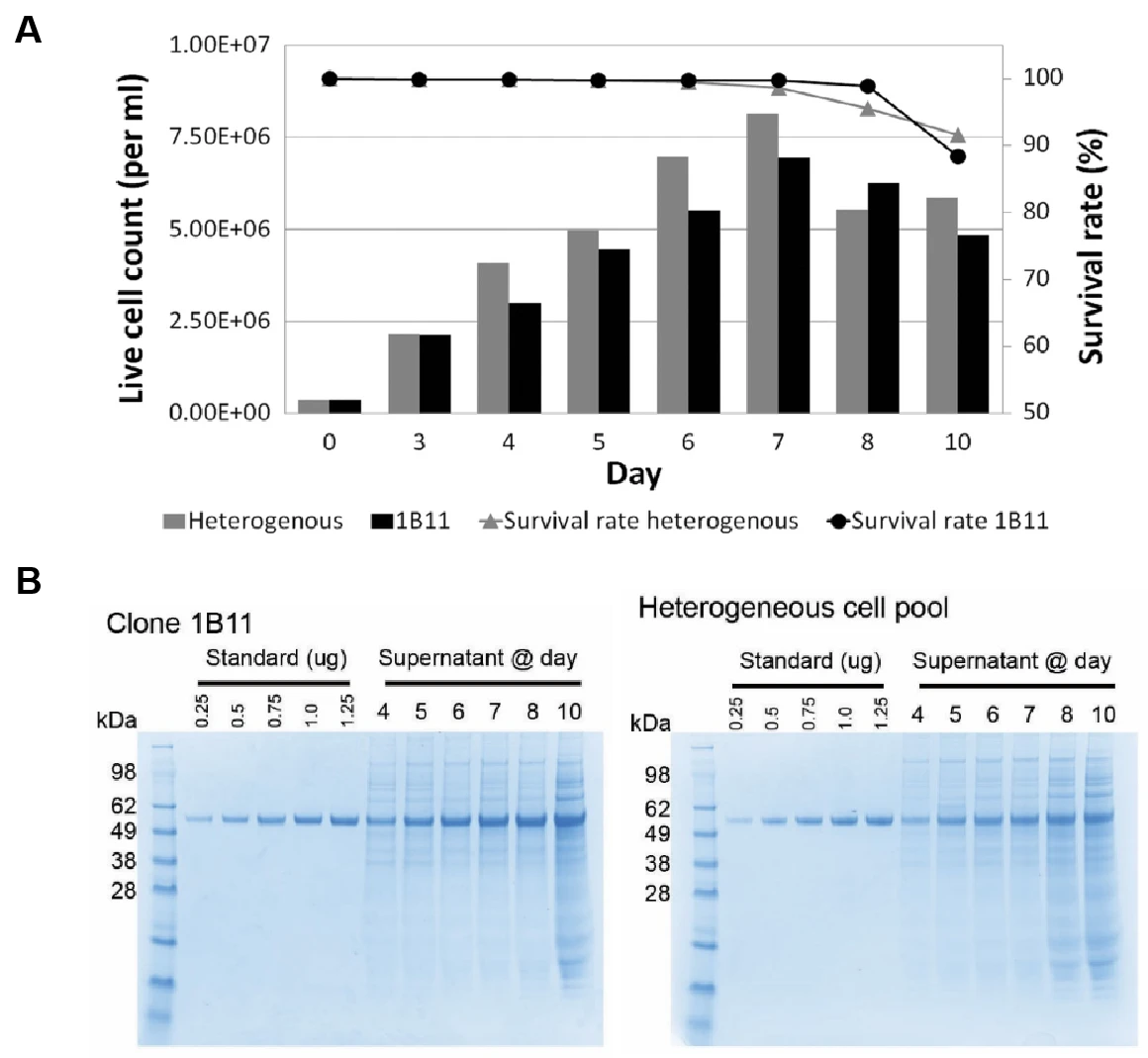
Stable cell lines also play a crucial role in vaccine research. For example, in MERS-CoV vaccine antigen production, researchers engineered susCHO cells to generate stable lines expressing the MERS-CoV protein, followed by single-clone selection. The resulting clones exhibited stable growth and excellent cellular condition, with protein expression levels 32 mg/L higher than those of pooled cells. These high-expression, well-characterized single clones provide a reliable platform for large-scale antigen production and process optimization. Through single-clone selection, researchers can ensure consistency and high yield across production batches, thereby significantly improving research efficiency and controllability in industrial applications.
6.Ubigene EZ-OE™: Next-Generation Genome Engineering for Accelerated Stable Cell Line Construction
Ubigene’s proprietary EZ-OE™ technology overcomes the limitations of traditional stable cell line generation methods, providing an efficient and safe solution for cell engineering. Unlike conventional lentiviral or transposon-based approaches, EZ-OE™ does not require viral vectors, enhancing experimental safety from the outset. The technology enables precise genomic integration with controllable gene copy number and stable expression, greatly improving reproducibility and reliability of experimental data. Moreover, EZ-OE™ offers significant advantages in construction timelines and cost-efficiency, making it suitable for large-scale research and industrial applications.
EZ-OE™ is widely applicable in gene function studies, quantitative expression model development, biomolecule production, and candidate drug screening. By using this technology, researchers can rapidly obtain stable, high-performing cell lines, providing a solid foundation for experimental design while significantly enhancing data reliability and overall experimental efficiency.
Conclusion: Stable Data Starts with Stability
High-quality research outcomes depend not only on rigorous experimental design but also on the stability and consistency of the underlying materials. Stable cell lines, particularly those derived from single-clone selection, provide long-term, reproducible gene expression, serving as a critical foundation for reliable data and successful manuscript publication. When facing challenges such as data variability, poor reproducibility, or manuscript review setbacks, starting with high-quality, professionally constructed Stable cell lines offers researchers a robust platform for success.
For researchers seeking to further enhance experimental efficiency and data reliability, or requiring tailored technical support for specific research needs, Ubigene offers professional guidance and services to ensure optimal results. Promotions