
Expert Insights | A Practical Guide for FACS-Based CRISPR High-Throughput Screening

Introduction
CRISPR library screening breaks through the limitations of traditional single-gene studies, enabling the unbiased screening of crucial genes that regulate cellular phenotypes. It serves as a core methodology for discovering functional genes and drug targets. For fluorescently trackable traits, such as cell surface molecules and reporter gene expression, fluorescence-activated cell sorting (FACS) can precisely isolate cells with distinct phenotypes. FACS-based CRISPR screening resolves sgRNA enrichment patterns through group sequencing, significantly boosting the screening efficiency of functional targets. This approach is highly applicable to target discovery in immunology and oncology.
I. Applications of FACS-Based CRISPR Screening
While FACS is not a universal solution for CRISPR library screening, it is virtually irreplaceable in a specific context: as long as you can convert a biological question into the intensity of a fluorescent signal, you can leverage FACS to discover targets.
The main types of screening targets include:
1. Regulators of Signaling Pathway / Transcription Factor Activity
Utilizing reporter gene systems (e.g., GFP driven by specific response elements) or immunostaining, pathway activity can be converted into fluorescent signal intensity. For instance, to screen for novel regulators of pathways such as NF-κB, Wnt, p53, or HIF-1α, researchers can sort out GFP-high or GFP-low cell populations, or combine immunostaining to sort out high/low-signal cells, thereby identifying positive or negative regulators of the target pathway.
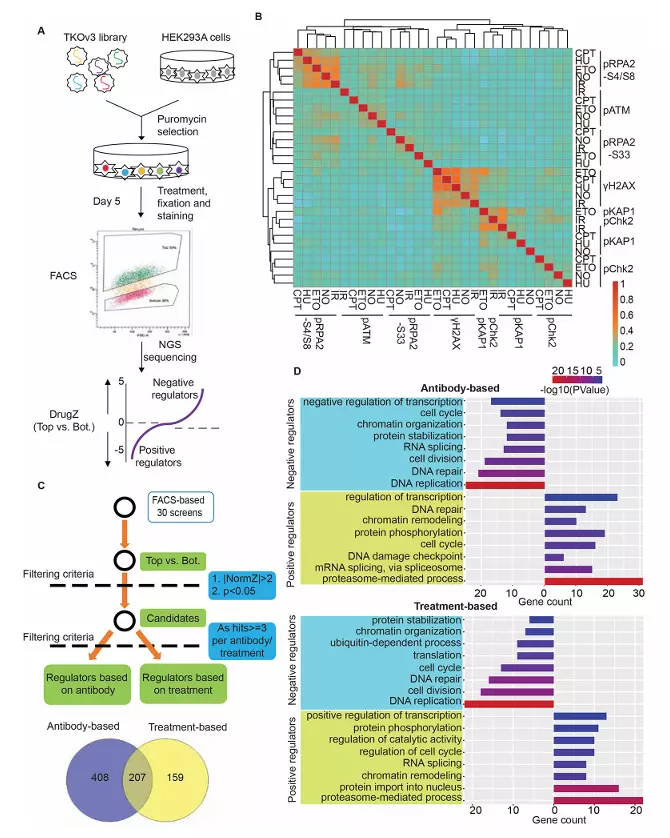
Figure A-D: Huang M, et al. Mol Cell. 2023
This study established and validated a FACS-based CRISPR screening platform, which can be applied to identify regulators of various signaling pathways, including the DNA damage response.
2. Regulators of Cell Surface Markers
Using flow cytometry to screen targets is the most widely adopted approach in immuno-oncology. For example, to identify genes regulating immune checkpoints or antigen-presenting molecules such as PD-L1, MHC-I, and CD47, cells can be directly stained with fluorophore-conjugated antibodies. Subsequently, cell populations with high or low surface protein expression are sorted, followed by Next-Generation Sequencing (NGS) analysis to pinpoint the regulatory genes. This strategy does not require reporter gene engineered models and can be performed directly on wild-type cell transfected with CRISPR libraries, rendering it highly physiologically relevant.
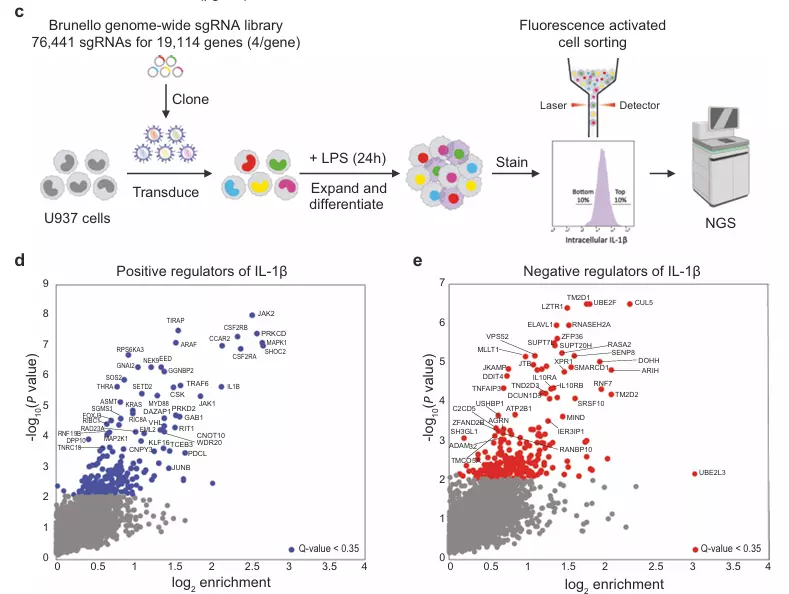
Figure C–E: Rahimov F,et al.Nat Commun. 2025
Utilizing a FACS-based CRISPR screening system, this study systematically identified 295 genes regulating IL-1β in human monocyte cell line.
3. Regulators of Cell Differentiation / Transdifferentiation / Stemness
By employing lineage-specific surface markers (e.g., CD133 for stem cells, specific markers for differentiated cells) or reporter stem cell lines, sorting positive/negative populations for differentiation markers allows the identification of genes driving or blocking specific differentiation processes.By employing lineage-specific surface markers (e.g., CD133 for stem cells, specific markers for differentiated cells) or reporter stem cell lines, sorting positive/negative populations for differentiation markers allows the identification of genes driving or blocking specific differentiation processes.
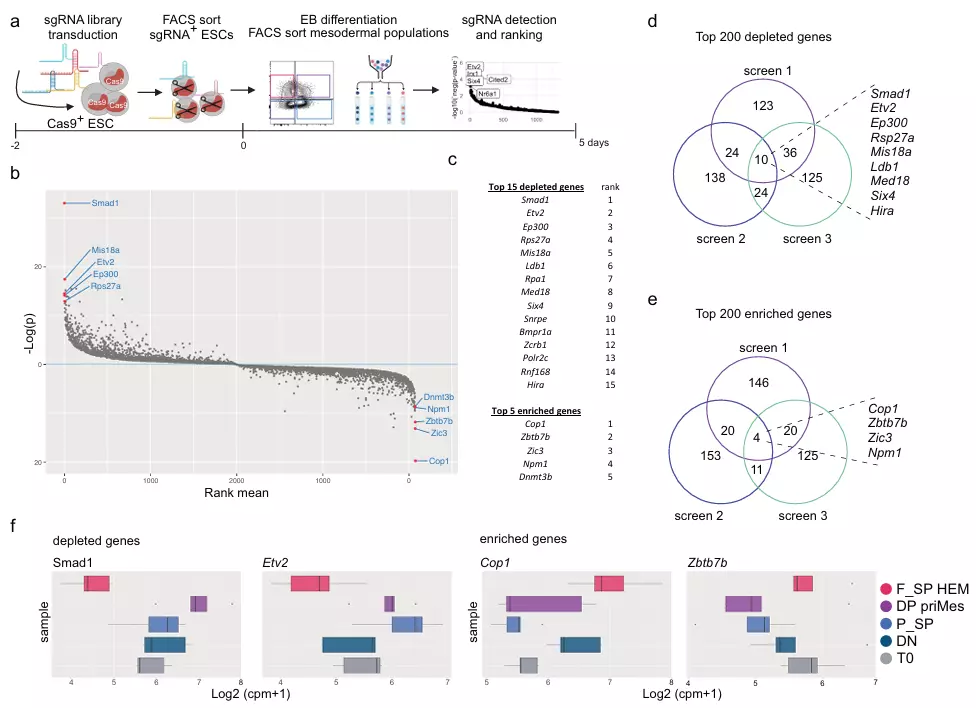
Figure A–F: Teske M,et al.Nat Commun. 2025
This study utilized flow cytometry-based genome-wide CRISPR screening to identify core transcription factors governing murine hemato-endothelial cell fate commitment.
4. Metabolite Sensing / Enzyme Activity Targets
Certain fluorescent probes can directly readout intracellular metabolic states, such as reactive oxygen species (ROS) levels, lipid content, and lysosomal pH. These probes can be used to sort out cell populations with shifted signals to screen for corresponding regulatory genes. Additionally, fluorescent substrate-based systems can be applied to screen for regulators of protease or kinase activities.
5. Host Factors Associated with Viral Infection / Bacterial Invasion
By using fluorescent-labeled pathogens or reporter viruses, sorting infection-positive or infection-negative cell populations enables the discovery of host invasion or restriction factors.
II. Key Steps of FACS in Library Screening
- Single-Cell Suspension Preparation: Perform enzymatic digestion or mechanical pipetting, collect cell suspensions and filter through a mesh strainer to ensure single-cell dispersion under sterile conditions.
- Staining and Labeling: Depending on the screening objectives, add viability dyes, surface antibodies, or directly detect the fluorescence of reporter genes.
- FACS Sorting: Gate the target populations (e.g., the top 10% GFP-high cells) on a flow cytometer, and sort them into collection tubes containing culture medium.
- Cell Recollect or Direct DNA Extraction: A portion of the sorted cells can be maintained in culture for subsequent validation, while the remaining cells are centrifuged to extract genomic DNA for deep sequencing of sgRNAs.
III. Troubleshooting for FACS-Based Screening
1. FACS is Inherently Prone to Higher False Positive Rates
Unlike drug selection, FACS fundamentally performs only a single round of physical enrichment on target cells. Many cells may temporarily enter the designated positive gate simply because they are in a specific cell cycle phase, undergoing metabolic fluctuations, or randomly expressing reporter genes at a high level. These "transient" false-positive cells are collected all at once during sorting, without subsequent natural elimination. Consequently, the candidate list generated by FACS naturally carries a higher false-positive rate compared to multi-round drug selection.
[Pro Tip] Run multiple rounds of enrichment by culturing the recollected cells and sorting them again to obtain a purer positive population. Additionally, increasing the number of experimental replicates can help filter out false-positive noise.
2. Ensure Sufficient Cell Numbers for Sorting
An insufficient number of sorted cells leads to poor library coverage, causing a large portion of sgRNAs undetected. Moreover, false-positive cells collected due to random sampling deviations will severely interfere the experimental results.
[Pro Tip] Typically, the top and bottom 5-10% of fluorescent cell populations are sorted out. To guarantee adequate coverage of the sorted cells, we recommend preparing at least 1*10^7 cells prior to sorting (and significantly more for genome-wide libraries).
3. Prevent Cell Clumping to Avoid Experimental Bias and Instrument Clogging
Cells used in library screening have undergone multiple steps, including lentiviral packaging, transduction, and resistance selection, which often increases membrane stickiness. If perform sorting with high cell density and large volume, micro-clumps can form easily. The flow cytometer recognizes these small clumps as a single event, causing data compromise, cell loss, or even nozzle clogging, which severely disrupts the sorting workflow.
[Pro Tip] Split cells into multiple aliquots for shaker-assisted staining to prevent poor antibody staining in dense cell concentrations. Add 1–2 mM EDTA and 25–50 U/mL DNase I to minimize cell aggregation. Always pass the cells through a 40 μm mesh filter immediately before sorting to prevent nozzle clogging.
4. Address Uneven Antibody Staining and Non-Specific Binding
Compared to routine flow cytometry analysis, FACS-based screening requires massive cell quantities, which often results in uneven staining and leaves a portion of cells unstained. Furthermore, poor antibody specificity can lead to sorting unwanted cell populations, heavily compromising data accuracy.
[Pro Tip] Perform preliminary experiments to validate antibody efficacy before the formal screening. Include negative controls (cells lacking target protein expression) and incorporate Fc block reagents to eliminate non-specific antibody binding.
5. Minimize Cell Damage During Sorting
FACS is a lengthy and stressful process for cells. It is crucial to minimize physical damage during sorting. Otherwise, rapid cell apoptosis and DNA degradation will follow, severely compromising downstream genomic DNA extraction and NGS.
[Pro Tip] Utilize ultra-high-speed sorting systems (such as the Beckman MoFlo Astrios EQ) to shorten sorting time. Additionally, add an appropriate volume of sorting buffer to the collection tubes to cushion the physical impact on the cells.
IV. Ubigene CRISPR Library Services
Ubigene has established a comprehensive phenotypic screening and data analysis platform tailored for various research scenarios. We offer meticulous in vivo and in vitro CRISPR screening services—from experimental design to result interpretation—to accelerate scientific progress. Ubigene's versatile phenotypic analysis platform supports a wide array of functional screening systems, fully covering workflows such as drug/virus treatment, subculturing, cell co-culture, FACS sorting, cell migration, and cell adhesion assays. Furthermore, Ubigene's iScreenAnlys™ Library Analysis Platform enables "one-click analysis" of library screening data. Supporting mainstream bioinformatics algorithms including Drug-Z, MAGeCK-RRA, and MLE, the platform can directly generate publication-ready figures and reports.
References
- Huang M, Yao F, Nie L, Wang C, Su D, Zhang H, Li S, Tang M, Feng X, Yu B, Chen Z, Wang S, Yin L, Mou L, Hart T, Chen J. FACS-based genome-wide CRISPR screens define key regulators of DNA damage signaling pathways. Mol Cell. 2023 Aug 3;83(15):2810-2828.e6. doi: 10.1016/j.molcel.2023.07.004. PMID: 37541219; PMCID: PMC10421629.
- Rahimov F, Ghosh S, Petiwala S, Schmidt M, Nyamugenda E, Shi M, Tam J, Verduzco D, Singh S, Avram V, Modi A, Espinoza CA, Lu C, Wang J, Keller A, Macoritto M, Mahi NA, Anton T, Chung N, Flister MJ, Katlinski KV, Biswas A, den Hollander AI, Waring JF, Stender JD. A genome-wide CRISPR screen identifies the TNRC18 gene locus as a regulator of inflammatory signaling. Nat Commun. 2025 Nov 24;16(1):10346. doi: 10.1038/s41467-025-65277-y. PMID: 41285767; PMCID: PMC12644769.
- Teske M, Wertheimer T, Butz S, Zwicky P, Mallona I, Nopper SL, Münz C, Elling U, Lancrin C, Becher B, Grosso AR, Baubec T, Schmolka N. Targeted CRISPR-Cas9 screening identifies core transcription factors controlling murine haemato-endothelial fate commitment. Nat Commun. 2025 Dec 13;16(1):11412. doi: 10.1038/s41467-025-66230-9. PMID: 41390669; PMCID: PMC12738756.
 Promotions